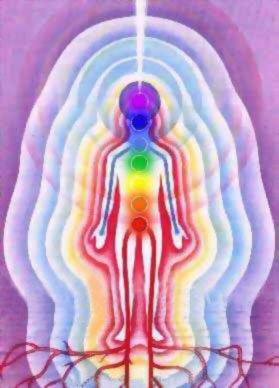
Everything is energy. Everything is vibration; it's just that some things vibrate at a higher speed than others. All matter is simply energy at varying levels of density.
 |
| Cell walls and biofields are semi-permeable, to allow nutrients in and waste out. |
|
The biofield, the energetic boundary around the body, is a semi-permeable membrane. It allows energy in and out. The body has semi-permeable membranes too--the mucus membranes in
particular, such as those of the nose or mouth or eyeballs. Even the
skin is semi-permeable. These physical semi-permeable membranes also allow energy in and out. This energy can be tangible, such as the energy that makes up the chair you are sitting on, or the food you are eating, or intangible, such as the thoughts sent in your direction or the thoughts you are thinking yourself.
 |
| A rendition of a human surrounded by the biofield. |
I have been learning over the course of months that it is the semi-permeable nature of our various energetic/spiritual membranes and physical bodily membranes that makes it so important to guard our inputs. Our energetic inputs, in the form of thoughts and so forth,
as I blogged earlier, but also our more physical inputs: the things we hear, the things we see, the things we wear, the things we eat. Everything we interact with interacts with our semi-permeable membranes and some of that energy--sometimes much of it or even all of it--can end up absorbed into our body or our energetic system.
To put it another way: everything we interact with leaves a physical change in our physical
and subtle bodies.
The scriptural case for the literal recording of events in our bodies
Consider
2 Corinthians 3:3, which contains the imagery of Christian discipleship being "written, not with ink, but with the Spirit of the living God" on the "fleshy tables of the heart."
This corresponds with
Mosiah 13:11, in which Abinadi claims that he "perceives" that the commandments of God are "not written in your hearts" (referring to the hearts of the wicked priests of King Noah). This scripture stands out to me because this is exactly how I would describe the sensation I have experienced, of perceiving what is and is not a part of someone's energetic or even physical body.
In
Jeremiah 31:33, Jeremiah explains that in the last days, the Lord would introduce a new covenant, and that the Lord would "put my law in their inward parts, and write it in their hearts."
There are plenty more scriptures in all the Standard Works that agree at least
literally with this idea of things being written on our hearts. The obvious implication is that the things we do and think and
are become a literal part of our flesh that can be read.
The case for caution in energetic and material inputs
In my research, I discovered a common warning that comes along with frequent use of theta brain states: theta states often result in spontaneous manifestations of the things a person thinks about. As I have been spending more and more of my time in a waking theta state, I've felt much more aware of how many things have the opportunity to permeate my semi-permeable membranes, both spiritual and physical. I've been more and more discerning in my choices of environments and thought patterns because I don't want to accidentally manifest something horrible in my life just because I saw something about it on TV or something.
PS, when we're doing it right,
prayer can put the brain in a theta state. The more time you spend praying, like
really praying (not that half-hearted stuff we kind of emit right before dinnertime sometimes when we're very hungry), the more likely you are to manifest the things you pray for or about. This includes the negative things we pray about--the things we don't want to happen. This is why it is important to frame prayers from a place of gratitude and humble requests of what we
do want.
This ability to manifest anything that is floating around in our systems adds a level of seriousness to the things we surround ourselves with:
The music we listen to in the car.
The TV shows we watch at night.
The words we speak and hear throughout the day.
The books we read.
The pictures we see.
The food we eat.
The clothes we wear.
The thoughts we think.
The people or things we allow to touch our private parts.
Every thing we interact with or allow near--or especially
in--our biofield or body has the opportunity to permeate our semi-permeable membranes and lodge there, causing good if it's a good thing or bad if it's a bad thing. Remember how the scriptures said that righteousness and discipleship can be written on the heart?
So can sin.
Darkness, sin, and the importance of forgiveness
It is becoming increasingly clear to me that sin isn't just our actively negative actions against others--it's also our choice, conscious or subconscious, to not forgive those who have sinned against us. Consider
D&C 64:9-10 (emphasis mine):
9 Wherefore, I say unto you, that ye ought to
a one another; for
he that b not his brother his trespasses standeth condemned before the Lord; for there remaineth in him the greater sin.
10 I, the Lord, will
a whom I will forgive, but of you it is required to
b all men.
Unforgiveness allows sin to remain literally "in" us, according to a plain-and-precious literal reading of this scripture. It is my observation that unforgiveness remains etched in our bodies, in the form of darkness and "
spiritual burlap" that can only be removed by the act of conscious, out-loud, for-real forgiving.
Sometimes our unforgiveness isn't malicious; it's just not a priority. It just doesn't seem important. For example, when was the last time you consciously, verbally forgave a public official you disagreed with for his negative public policies that affect your life?
When was the last time you verbally forgave a nurse for keeping you waiting at the doctor's office?
When was the last time you verbally forgave a driver for cutting you off on your way to work?
So many times, these minor offenses, or offenses that don't seem aimed personally at us, can just slip under our radars as things we just need to let go. But it appears to me that in reality, these issues are still trespasses, they still cause a negative energetic shift in our bodies and spirits, and they still require our conscious, chosen forgiveness, or else
in us there lies the greater sin.
Note that phrasing. It is not necessarily that we are the bigger or worse sinners; it is that there is sin
lying in us. The sins which affect us, though perpetrated by others, no matter how small they are, somehow may remain "in" us, according to a literal read of the scripture.
The negative energy generated by these offenses can stick with us and affect us, even if they seem minor to us and not even a big enough deal to forgive. Even a minor trespass requires our forgiveness, if it affects us negatively in any way. Even a little bit of negative, or dark, or unclean energy is too much to keep with us:
no unclean thing can enter the kingdom of heaven.
Living at this level of consciousness and forgiveness does require a lot of energy (ha, ha). But literally. It does. I am definitely not a master at it yet because it does require a lot. It requires a very high level of consciousness and mindfulness to go through each day aware of every thing, good and bad, that enters the biofield--and then, not just be aware, but consciously forgive with love the trespasses that cause darkness in our space. (Side note: forgiveness doesn't mean accepting sin; it means accepting another of God's children, who has sinned. It is not saying that sin is okay, because sin is never okay. It is saying that you accept the sinner despite the sin.)
The good thing is, the more we forgive, the more energy we have floating around us to help us forgive even more.
Protecting the biofield against darkness
I've been pondering how it could be that Jesus or the prophets could live with their energy basically intact despite psychic attacks of negativity on their biofields. Just think of the hate and negativity spewed every day toward our beloved Father in Heaven and His Son Jesus Christ. Even otherwise good people openly and vilely abuse Their names and accuse Them of all sorts of false and horrible things. And yet, despite such attacks of darkness, They remain completely and only and wholly Light.
Prophets have got to be the next level of being out there as far as light in biofields goes, but of course, many prophets over history didn't keep their energies intact; think of David, who succumbed to sin, or the Brother of Jared, who forgot to pray for literal years. Clearly even big-P Prophets do not always operate at a high level of consciousness regarding their biofields.
But it seems to me that when a person's inner soul is righteous enough, they generate enough light that their inner light prevents any darkness from entering their space. Instead of the biofield acting as a mere membrane for them, it is more like the glass of a light bulb, allowing the light of their righteousness to shine out, with no possibility of darkness entering. Consider John's description of God:
5 This then is the message which we have heard of him, and declare unto you, that God is light, and in him is no darkness at all.
God's person, and Jesus's person, is light, with no darkness at all. This is the promise given to
us if we will keep the commandments:
- Doctrine and Covenants 88:67 And if your eye be single to my glory, your whole bodies shall be filled with light, and there shall be no darkness in you; and that body which is filled with light comprehendeth all things.
Just
look at that! I had to bold the whole thing! I couldn't even help myself! What a promise! If we can keep our eyes single to God's glory, what do we get?
- whole bodies filled with light
- no darkness in us
- full comprehension of all things
What an amazing promise!
Fascinatingly, my observations have been that health, emotional, spiritual, and physical, registers as literal light emanating from a person, while disease of an emotional, physical, or spiritual nature registers as darkness. It seems to me that complete personal righteousness leads not just to full comprehension of all things and a very radiant Self, but
also to complete health.
Conclusion
So, to bring this full circle:
We have to guard our semi-permeable membranes.
We have to understand that the guidelines in
For The Strength of Youth are more than just cute ideas: they are
relevant, they are
important, they pertain directly to the cleanliness and light of our spirits and
our eternal salvation.
Watching a rated-R movie fills our spaces with darkness and our bodies with darkness as images seep into us through our biofields and our semi-permeable eyeball tissue.
Listening to impure music allows the darkness of it to enter our bodies through the ear canal.
Eating food or using substances prohibited by
the Lord's Law of Health, or Word of Wisdom, fills our literal bodies with darkness--it's actually worse than that because the things we ingest are the building blocks for our bodies... it's not just that we eat bad things and have darkness as a result; our bodies are
made of darkness as a result.
Participating in sexual activity with anyone (including the self) outside of marriage fills us with darkness; it's actually worse than that because sexual contact of any kind outside marriage, from what I have observed, creates distorted etheric cords with the other person or even the self (in the case of self-abuse). These fracture our souls and further drain us of light.
Dishonesty stains us with darkness.
On the other hand, things
For The Strength of Youth encourages, such as honesty, service, self-reliance, chastity, tithing, and so forth, actually fill us with and maintain inner light and peace.
The Gospel is not easy, but it
is simple. My recent life experiences have led me to conclude that the scriptures are much plainer than they appear to be: much of what can be mistaken for metaphor is actually literally true, if you
have the eyes to see it.